
The rupee slumped 5 per cent in 2025 as persistent capital outflows from foreign investors, alongside heightened dollar demand from importers, making it one of the worst-performing Asian currencies.

Saptak Talwar and Dhruv Sheoran emerged as joint leaders after the third round of the DP World PGTI's Indorama Ventures Open Golf Championship, with Manu Gandas close behind.

Assessing where their funds are flowing gives traders a hidden edge in predicting the market direction and momentum.

The rupee breached 90-levels against the greenback for the first time on Wednesday, falling 6 paise to 90.02 in early trade, as banks kept buying US dollars at higher levels and FII outflows continued.

'In the long run, India's strong growth story and reforms to make assets globally attractive will determine the rupee's resilience.'

Is the parabolic rise in silver running out of steam or just getting started? Ramalingam Kalirajan offers his take on if you should invest in silver now?

Stock markets are likely to trade in a range-bound manner in a holiday-shortened week where trading activity of foreign investors, currency movement and global macroeconomic data announcements are expected to drive sentiments, analysts said. Several global markets may see subdued activity on account of Christmas and New Year holidays, an expert said.

Economic Advisory Council to the Prime Minister (EAC-PM) member Sanjeev Sanyal on Thursday said he is not concerned about the rupee at all, arguing that even China and Japan witnessed exchange rate weaknesses during their high growth phases.

The rupee plunged 58 paise to close at an all-time low of 81.67 (provisional) against the US dollar on Monday as the strengthening of the American currency overseas and risk-averse sentiment among investors weighed on the local unit. Moreover, escalation of geopolitical risks due to conflict in Ukraine, a negative trend in domestic equities and significant foreign fund outflows sapped investor appetite, forex traders said. At the interbank foreign exchange market, the local currency opened at 81.47, then fell further to close at an all-time low of 81.67 against the American currency, registering a decline of 58 paise over its previous close.

Investors must account for currency depreciation in their financial plans and use instruments that can cushion the erosion in purchasing power.

The 25 per cent US tariffs, plus a penalty for Russian imports, could dent India's GDP growth by 30 basis points in the current fiscal, but the higher duty is unlikely to significantly affect India's domestic demand-driven economy, Barclays said on Thursday. If the 25 per cent tariff, announced by US President Donald Trump on Wednesday, is implemented from August 1, the effective average US import tariff on Indian goods will rise to 20.6 per cent in trade-weighted terms, as per Barclays estimates.

The rupee declined 22 paise to 87.41 against the US dollar in early trade on Thursday after the latest tariff announcements from the US weighed on emerging currencies, including the rupee. Forex traders said the latest tariff announcements from the US have sent shockwaves through global markets, strengthening the dollar.

The rupee depreciated 39 paise to an all-time low of 82.69 against the US dollar in early trade on Monday as elevated crude oil prices and risk-averse sentiment among investors weighed on the local unit. Moreover, a negative trend in domestic equities and firm American currency sapped investor appetite, forex traders said. At the interbank foreign exchange, the rupee opened at 82.68 against the greenback, then slipped further to 82.69, registering a fall of 39 paise over its previous close.

The recent depreciation of the rupee along with sharp fall in the country's foreign exchange (FX) reserves has sparked a debate whether stability of the exchange rate is necessary and desirable. The rupee was one of the least volatile currencies among peers for almost two years before the current downward pressure started in September after the US Federal Reserve lowered interest rate.

India's rupee is likely to remain under pressure due to high prices of crude oil and other commodities, and may stabilise at around 79-80 against the US dollar in the near term, say experts amid limited headroom available with the Reserve Bank to check the weakening of the domestic currency. The currency has slumped over 5 per cent this year after Russia's invasion of Ukraine sent international crude oil prices soaring to a decade high. On Monday, rupee ended at a fresh all-time low of 78.34 (provisional) against the US dollar.

The bank adds it expects Modi to fight inflation through administrative measure

In the global market, the US dollar index, which tracks the greenback against a basket of six major rivals, was up by 0.33 per cent.

The ongoing conflict between Ukraine and Russia is unlikely to have any major impact on the Indian rupee and the forex volatility in the country (USD/INR) has been much less now as compared to the global financial crisis which took place in 2008, SBI said in its Ecowrap research report. The report said that though the conflict between the two CIS nations may drag on for now, it is expected that the USD/INR, the most tracked pair in the local forex market, will trade at an elevated zone. But ideally, the expected average range of the rupee is expected to be in the band Between Rs 76 to Rs 78 to the USD with an appreciated bias.

Technically, USD/INR remains well below its 200-day moving average after first breaching that trend level on Thursday for the first time since May 2013, adding to the optimism on the rupee.
For the last three weeks, we had been warning about substantial weakness in the six month forward premiums on USD/INR, and had called for the six-month forwards testing the 41.50/44.50 level.

The Reserve Bank of India (RBI) will have to take far more pro-active steps to rebuild forex reserves, because if the status quo remains, rupee could touch 75 per US dollar by the end of 2014, Bank of America Merrill Lynch said in a report.

Continuing the downward trend, retail inflation fell to a five-month low of 4.31 per cent in January, mainly due to a decline in the prices of vegetables, eggs, and pulses. The Consumer Price Index-based retail inflation was 5.22 per cent in December and 5.1 per cent in January 2024. The previous low inflation was in August 2024 at 3.65 per cent.
The rupee plunged 20 paise to close at an all-time low of 78.13 against the US dollar on Monday, as a lacklustre trend in domestic equities and stronger greenback overseas weighed on investor sentiments. Forex traders said weak Asian currencies and persistent foreign capital outflows were the other major factors that dragged the local unit down. At the interbank foreign exchange market, the local currency opened at 78.20 and witnessed an intra-day high of 78.02 and a low of 78.29 against the US dollar.

The depreciation of Indian rupee against the US dollar is expected to push the country's import bill by about $15 billion, think tank GTRI said on Thursday. Compared to December last year, the Indian Rupee (INR) has depreciated 2.34 per cent against the US dollar, moving from Rs 83.25 to Rs 85.20, while the Chinese Yuan has weakened by 0.06 per cent, the Global Trade Research Initiative (GTRI) said.

The Indian rupee depreciated a modest 2.9 per cent in the first nine months of the current fiscal, performing better than other currencies like the Canadian Dollar, South Korean Won and the Brazilian Real, according to the Economic Survey tabled in Parliament on Friday. The value of the Indian Rupee (INR) is market-determined, with no target or specific level or band.
The rupee depreciated by 9 paise and settled at its all-time low level of 83.13 against the US dollar on Wednesday, weighed down by a surge in crude oil prices and strong American currency. Forex traders said the Indian rupee depreciated as the US dollar rose to the highest levels in six months. Moreover, elevated crude oil prices also weighed on rupee.

Persistent foreign capital inflows also boosted sentiment.

According to HSBC, one key focus point for the market is whether the government stands its ground on foreign direct investment in multi-brand retail or if it gives in to pressure from the opposition.
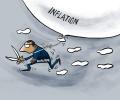
Wholesale price based inflation declined to a 3-month low of 1.89 per cent in November on cheaper food items, and experts predicted a 0.25 per cent interest rate cut by the RBI in the policy review in February. The Wholesale Price Index (WPI) based inflation was 2.36 per cent in October 2024. It was 0.39 per cent in November, last year. In August, 2024, it was 1.25 per cent.

Ask rediffGURU and tax expert Mihir Tanna your income tax-related questions.

The rupee on Friday rebounded from the near-80 levels to close higher by 17 paise at 79.82 against the US currency following a recovery in the domestic stocks and weakness in the greenback in overseas markets. The US dollar retreated from the two-decade high levels against a basket of six currencies which supported the rupee sentiment. At the interbank foreign exchange market, the local currency opened at 79.95 and witnessed an intra-day high of 79.82 and a low of 79.96 against the US dollar in the day trade. ,

Wholesale price inflation (WPI) declined to a 14-month low of 0.39 per cent in May on easing prices of food articles and fuel, and experts said geopolitical tensions could push up prices.

RBI banned banks from proprietary trading and Sebi doubled the margin requirement on the domestic dollar-rupee forward trade.

BCCI could earn USD 1.15 billion in revenue share from the ICC during the next five-year cycle.
The rupee on Tuesday lost another 15 paise against the US dollar to close at 65.88

The Indian rupee is likely to depreciate further against the US dollar through the end of 2024. This is due to the continued strengthening of the greenback, combined with the weakening of the Chinese yuan, which is expected to keep pressure on the Indian currency.

The rupee on Tuesday fell by 25 paise to 65.05 on fresh dollar demand from banks and importers despite persistent foreign capital inflows.

The dollar index was down by 0.02 per cent against a basket of six major currencies.

The rupee plunged 90 paise to close at an all-time low of 80.86 (provisional) against the US dollar on Thursday after the US Federal Reserve's interest rate hike and its hawkish stance weighed on investor sentiments. Forex traders said the US Fed's rate hike and escalation of geopolitical risk in Ukraine sapped risk appetite. Moreover, the strength of the American currency in the overseas market, a muted trend in domestic equities, risk-off mood and firm crude oil prices weighed on the rupee.

A Dhaka court has ordered the freezing of 31 bank accounts linked to ousted prime minister Sheikh Hasina, her family members and their associates over corruption allegations. The accounts, holding a total of Tk 394.6 crore (INR 281.2 crore approximately), belong to Hasina, her son Sajeeb Wazed Joy, daughter Saima Wazed Putul, sister Sheikh Rehana, nephew Radwan Mujib Siddiq Bobby and their related organizations. The Anti-Corruption Commission (ACC) claims Hasina and others are trying to transfer the money from these accounts, prompting the court to issue the freezing order.
